Oshawa sits at roughly 43.90°N, draped over a complex sequence of glacial till, Lake Iroquois beach sands, and younger alluvial valleys feeding into Lake Ontario. Where loose, saturated granular soils exceed 3 to 4 meters in thickness, conventional shallow footings become a gamble. In 2024 the city processed over 2,000 building permits, many on post-glacial deposits that demand engineered ground improvement. Vibrocompaction design transforms these deposits into a competent bearing stratum by rearranging soil particles into a denser state. The process uses depth vibrators to induce horizontal oscillations, collapsing the grain skeleton and dissipating excess pore pressure. For sites near the Harmony Creek floodplain or the older industrial waterfront, a site-specific vibrocompaction design cuts liquefaction risk and limits total settlement to under 25 mm. We calibrate probe spacing, vibration frequency, and dwell time against real CPT data, then validate with post-treatment CPT testing to confirm the design target.
A well-designed vibrocompaction grid in Oshawa’s loose beach sands can raise SPT N-values from 8 to 25 in a single shift, eliminating the need for deep foundations.
Our approach and scope
Local ground factors
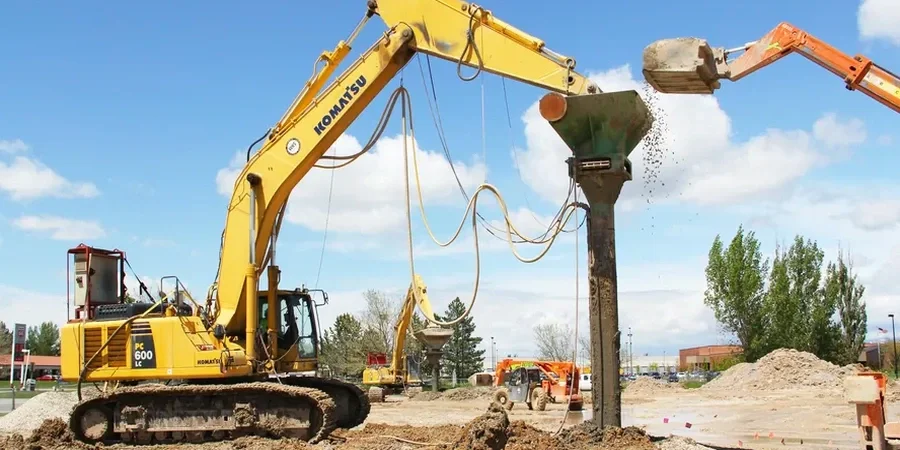
A 130 kW electric vibroflot with a 300 mm diameter probe head and integrated water jets is the workhorse on Oshawa sites. The risk lies not in the machine but in the soil’s response: silty lenses can choke the pore-pressure dissipation, trapping excess pressure and leaving the sand loose despite multiple passes. If the design misjudges the fines content, the result is a false-positive densification that collapses later under foundation load. Older masonry buildings within a 15-meter radius of the grid face vibration-induced cracking when peak particle velocity exceeds 10 mm/s; continuous seismograph monitoring at the lot line is mandatory. A pre-construction condition survey of adjacent structures, coupled with real-time amperage logs from the vibroflot data recorder, provides the documentary chain needed for CSA A23.3 compliance and municipal permit close-out.
Regulatory framework
NBCC 2020 (Part 4, Seismic Hazard and Site Classification), CSA A23.3: Design of Concrete Structures (seismic provisions), ASTM D6066: Standard Practice for Determining the Normalized Penetration Resistance of Sands, OPSS.MUNI 206 (Ontario Provincial Standard Specification for Granular Fill)
Other technical services
Vibrocompaction Trial Program
A full-scale test grid on one corner of the site to confirm probe spacing, frequency, and amperage settings before production work begins.
Production Grid Design & Monitoring Plan
Final compaction layout with sequence, withdrawal rates, real-time recording thresholds, and a seismograph monitoring plan for adjacent structures.
Post-Treatment CPT Verification
Cone penetration testing on a 5-meter offset grid to measure the achieved tip resistance and confirm relative density meets the design brief.
Liquefaction Mitigation Report
A standalone report documenting pre- and post-treatment SPT/CPT data, factor of safety against liquefaction under the 2,475-year return period, and as-built grid coordinates for the municipal record.
Typical parameters
Common questions
What does vibrocompaction design cost for a typical Oshawa residential lot?
For a single-family lot requiring 4 to 6 meters of treatment under a footprint of roughly 100 m², the design package including trial program, production plan, and post-treatment CPT verification runs between CA$1.710 and CA$8.190 depending on access constraints and the number of verification soundings.
Can vibrocompaction be used beside an existing 1950s basement in central Oshawa?
Yes, but with restrictions. The design must cap peak particle velocity at 10 mm/s at the foundation wall, which usually means a standoff distance of at least 3 meters and a reduced vibration frequency on the outermost probe passes. A pre-construction crack survey is mandatory.
How long does a vibrocompaction program take on a mid-size commercial site?
A typical 800 m² treatment area with a 2.5-meter triangular grid takes 3 to 4 production shifts. The trial program and post-treatment CPT verification add another 2 days on site, so total field time is about one week.
What CPT tip resistance confirms adequate densification?
We target a normalized cone tip resistance (qc1N) above 120 for a clean sand site classified as NBCC Class C. The exact threshold is set during the trial program and correlated to the target relative density of 70 percent or higher.