Oshawa’s industrial expansion from a modest lakeshore settlement into a major automotive and logistics hub has placed increasing demands on subsurface investigation. The city sits atop a complex glacial stratigraphy — tills, sands, and silts deposited by the Lake Ontario ice lobe — where hidden sand lenses and buried channels can complicate foundation design. Our laboratory team uses vertical electrical sounding to resolve these layers without disturbing the ground. By injecting current and measuring apparent resistivity at expanding electrode spacings, we build a 1D geoelectric profile that distinguishes compact lodgement till from water-saturated granular units. This matters when planning deep excavations near the Oshawa Creek or siting structures on the thick overburden that blankets the limestone bedrock at variable depths of 15 to 50 metres. The method integrates naturally with CPT testing where direct push data calibrates resistivity trends across the site.
A resistivity sounding in Oshawa’s glacial terrain can distinguish a clean sand aquifer from silty till within a 2-metre vertical interval — precision that mechanical boreholes alone do not provide.
Our approach and scope
Local ground factors
Oshawa sits at roughly 100 metres elevation on the south slope of the Oak Ridges Moraine, and its buried valleys — such as the one traced beneath the downtown core — can carry coarse-grained sediments with high groundwater transmissivity. In 2022, a localized sinkhole near a stormwater trunk line on Simcoe Street highlighted the consequences of unexpected subsurface voids in these ancient channels. Electrical resistivity testing detects such features because air-filled or water-saturated voids produce sharp resistivity contrasts against surrounding till. Overlooking a VES survey before placing heavy-footprint structures or stormwater infiltration galleries risks encountering undocumented sand seams that act as preferential flow paths, potentially triggering differential settlement or groundwater mounding beneath foundations. On brownfield sites south of Highway 401, where historical fill overlies natural deposits, resistivity data also flags zones of metallic debris or contaminated pore fluids that can skew conventional soil sampling results and mislead geochemical assessments.
Regulatory framework
ASTM D6431-18 Standard Guide for Using the Direct Current Resistivity Method for Subsurface Site Characterization, National Building Code of Canada (NBCC 2020) — Subsurface Investigation requirements for seismic site classification, CSA A23.3-14 Design of Concrete Structures — reference for geotechnical parameters in foundation design, Ontario Regulation 153/04 (Brownfields) — guidance on geophysical screening for site characterization
Other technical services
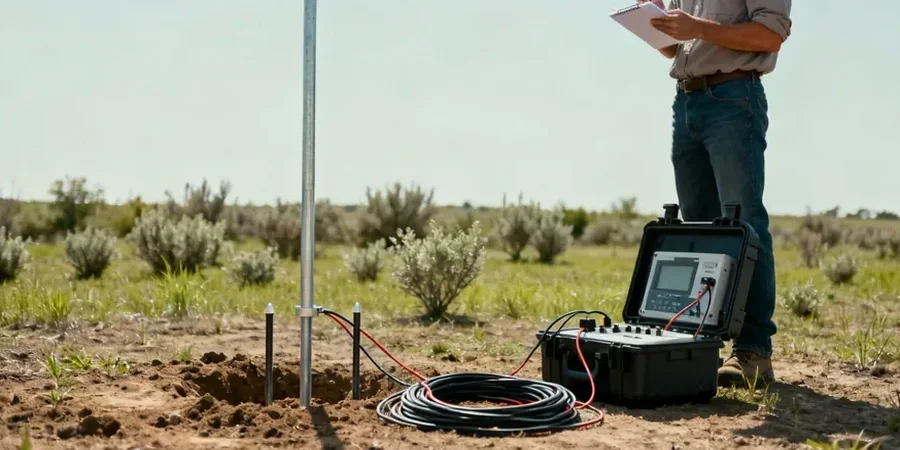
VES Sounding Array Deployment
Full Schlumberger array layout with GPS-referenced centre points, calibrated current injection, and automatic stacking to suppress cultural noise from Oshawa’s power grid.
1D Inversion and Geoelectric Modeling
Smooth and layered inversion routines that resolve true resistivity versus depth, with uncertainty bounds provided for each interpreted layer boundary.
Stratigraphic Interpretation and Cross-Sections
Conversion of resistivity logs to soil/rock units using local borehole logs and CPT correlations; fence diagrams for multi-sounding projects.
Groundwater and Contaminant Plume Mapping
Resistivity profiling to delineate fresh/saline interfaces, leachate plumes, and perched water tables in industrial and brownfield settings.
Typical parameters
Common questions
What depth can a VES survey reach in Oshawa’s overburden?
With a maximum current electrode half-spacing (AB/2) of 120 metres, we typically achieve an investigation depth of 60 to 80 metres in Oshawa’s glacial deposits. This reaches well into the bedrock surface across most of the city, including the deeper overburden pockets north of Taunton Road. The actual depth of penetration depends on the resistivity contrast between layers — conductive clay-rich till attenuates signal more than dry sand, so we adjust the maximum electrode spread based on preliminary site data.
How much does electrical resistivity testing cost for a site in Oshawa?
For a standard VES survey in the Oshawa area, including mobilization, field acquisition, data processing, and a full interpretation report, costs typically range from CA$740 to CA$1,390. The final figure depends on the number of soundings required, maximum investigation depth, and site accessibility — for example, surveys on paved industrial lots with traffic control needs fall at the higher end of the range.
Can VES distinguish between clean sand and silty sand?
Yes, to a degree that is very useful for geotechnical screening. Clean saturated sands typically show resistivity values above 100 Ω·m, while silty sands with higher fines content drop into the 30–80 Ω·m range. We calibrate these thresholds against grain-size analysis and CPT soil behaviour type from nearby boreholes to build a site-specific resistivity-to-lithology transform, which then guides interpolation between mechanical investigation points.
Does cultural noise from Oshawa’s infrastructure affect VES data quality?
Cultural noise from buried power lines, rail corridors, and industrial facilities is a real concern in Oshawa. We mitigate it by orienting the array perpendicular to known linear noise sources, using a resistivity meter with high common-mode rejection, and applying automatic stacking routines that average out 50/60 Hz interference. Where noise levels remain elevated, we switch to a time-domain IP-capable instrument and acquire full-decay waveforms for post-processing filtering.