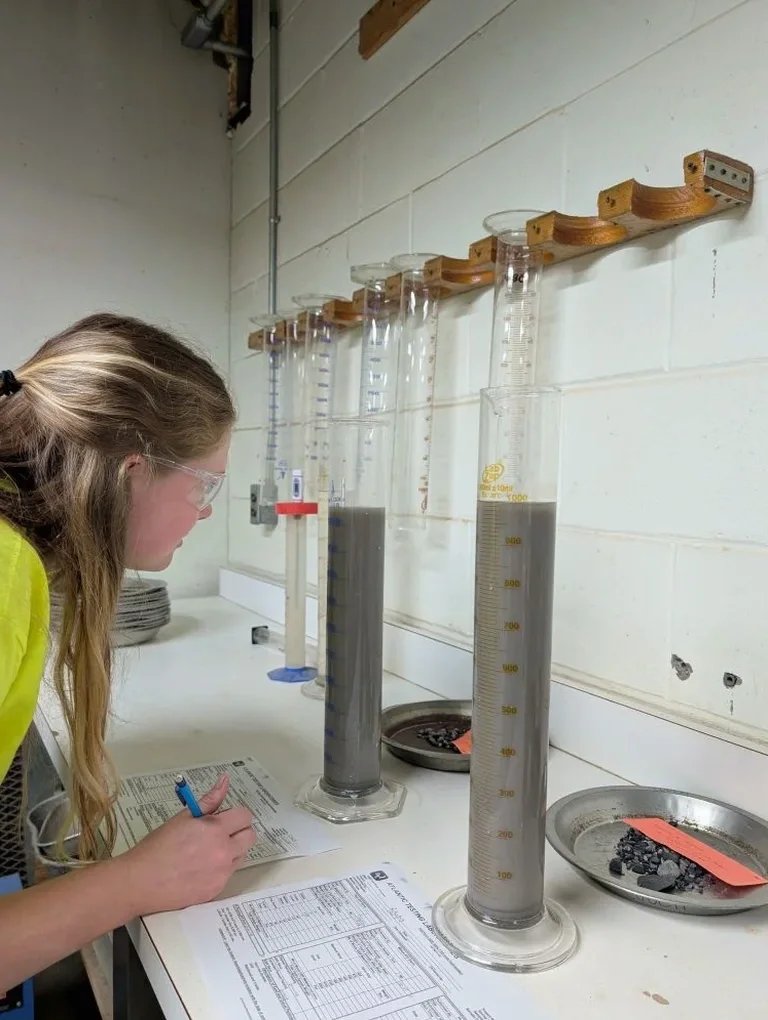
The laboratory CBR test in Oshawa starts with a standard compaction mold and a 4.5-kg rammer dropping from 457 mm. We compact three identical specimens at different moisture contents, then soak them for 96 hours to simulate the worst-case saturation that Oshawa subgrades face each spring. Given the city’s position on the glacial Lake Iroquois plain, the lacustrine silts north of Taunton Road and the clay tills south of Rossland behave very differently under repeated loading. The soaked CBR value we measure at 2.5 mm and 5.0 mm penetration tells the pavement designer exactly what bearing capacity to expect after frost leaves the ground in late March, which is when the regional road network around Oshawa is most vulnerable to softening and rutting. For granular base course materials brought from pits near Clarington, we also run unsoaked CBR to verify compliance with OPSS 1010 before the material reaches the job site.
A 2% difference in soaked CBR can mean the difference between 150 mm and 250 mm of granular base in Oshawa’s frost-susceptible silts.
Our approach and scope
Local ground factors
A six-storey residential block on Bloor Street East went into excavation with a design CBR assumed at 8% based on a desktop study. The native soil was a laminated silt with thin clay seams typical of the Halton Till. After the first heavy rain, the exposed subgrade turned to slurry, and the contractor had to over-excavate 600 mm and import granular fill at significant cost. We were called in to run laboratory CBR tests on the actual formation material, and the soaked values came back between 2.5% and 3.5%. The pavement structure was redesigned with a thicker base course and a geotextile separator. Skipping the lab CBR on glacial deposits in Oshawa is a gamble. The lacustrine silts north of the 401 look uniform on a borehole log but can lose 60% of their bearing capacity when saturated, and that number doesn’t appear in any textbook—it only shows up in the load-penetration curve.
Regulatory framework
ASTM D1883-21 Standard Test Method for California Bearing Ratio, CSA A23.1 Concrete Materials and Methods of Concrete Construction, OPSS 1010 Material Specification for Aggregates, MTO Laboratory Testing Manual LS-700, ASTM D698 / D1557 Standard Proctor Compaction
Other technical services
Soaked CBR (ASTM D1883)
Full 96-hour soak with swell monitoring. We measure the expansion of each specimen daily and report the final swell percentage alongside the CBR value at 2.5 and 5.0 mm penetration.
Unsoaked CBR for Base Course
Immediate penetration testing at optimum moisture content. Used for granular A and B materials to confirm compliance with OPSS 1010 before delivery to Oshawa road projects.
Compaction Curve + CBR Package
We determine the moisture-density relationship first, then compact CBR specimens at the target density. This combined package reduces turnaround time and ensures the CBR value corresponds to real field compaction.
Typical parameters
Common questions
How much does a laboratory CBR test cost in Oshawa?
A single-point soaked CBR test in our Oshawa lab runs between CA$190 and CA$310 depending on whether we need to establish the compaction curve first or if you supply the optimum moisture and maximum dry density. A three-point CBR package with the full Proctor curve included typically falls in the upper end of that range.
How long does the CBR test take?
The soaking phase alone takes 96 hours per ASTM D1883. After soaking, we run the penetration test and data analysis within one working day. Realistically, you receive the final report five to six business days after the sample arrives at our Oshawa lab.
Do you test both disturbed and undisturbed samples?
ASTM D1883 is designed for remolded, compacted specimens. If you need the bearing ratio of an undisturbed sample taken from a test pit in Oshawa, we can run a similar penetration test on the intact core, but we will note that the result is not a standard CBR value.
What penetration depth do you report?
We always report the CBR at 2.5 mm and 5.0 mm penetration. If the corrected load at 5.0 mm yields a higher ratio than at 2.5 mm, we re-run the test. The lower of the two values governs the design per ASTM D1883.
Can you test recycled concrete aggregate for CBR?
Yes. We test RCA and other recycled materials regularly for Oshawa projects. The oversized particle correction per ASTM D1883 applies if more than 20% is retained on the 19 mm sieve, and we document the scalping procedure in the report. More info.