The National Building Code of Canada (NBC) and CSA A23.3 embed soil classification as a prerequisite for any foundation design, and in Oshawa that means confronting a complex legacy of glacial Lake Iroquois deposits and dense Halton Till. The Atterberg limits — liquid limit, plastic limit, and plasticity index — serve as the primary identifiers for fine-grained soils, quantifying how a clay or silt behaves under varying moisture content. In Oshawa’s residential subdivisions north of Taunton Road and commercial developments near the 401 corridor, the transition from stiff silty clay to sandy till can occur within a single meter of depth. A contractor ignoring that transition risks specifying a footing bearing on soil that will soften significantly during a wet spring. The lab team runs ASTM D4318 with multi-point liquid limit determinations, never relying on the one-point method when the stakes involve a deep excavation or a retaining structure. For sites where the upper crust overlies softer varved clay, we often pair this test with triaxial shear testing to correlate plasticity with undrained shear strength, giving the structural engineer a complete picture of the soil’s mechanical response.
A plasticity index above 25% in Oshawa's lakebed clay signals a soil that will govern the foundation design, not the structural loads.
Our approach and scope
Local ground factors
Oshawa sits atop a former glacial lakebed, and the surface geology map for the city reveals extensive tracts of glacio-lacustrine clay and silt, particularly south of Rossland Road and along the Oshawa Creek valley. These deposits are characterized by high natural water content and a plasticity index that can exceed 30%, making them highly susceptible to volumetric change. The real risk is differential heave and shrinkage: a slab-on-grade built on a clay with a liquid limit above 50% will move seasonally as the water table, typically found between 2 and 4 meters depth in the southern half of the city, fluctuates through wet-dry cycles. When the plasticity index is misinterpreted — or worse, never measured — the result is cracked foundations, distorted door frames, and utility connections that shear within the first three years. For projects near the Harmony Creek floodplain, where organic silts are common, the liquid limit alone can indicate whether the soil will behave more like a viscous fluid than a solid during a 50-year storm event. The team also integrates findings with slope stability analysis when the excavation cuts into the sidewalls of the former shoreline bluffs that define Oshawa’s topography south of Bloor Street.
Regulatory framework
ASTM D4318-17e1 Standard Test Methods for Liquid Limit, Plastic Limit, and Plasticity Index of Soils, CSA A23.3 Design of Concrete Structures (referenced for foundation soil classification), Ontario Provincial Standard Specifications (OPSS) for earthworks material classification, National Building Code of Canada (NBC) Section 4.2 — Foundations
Other technical services
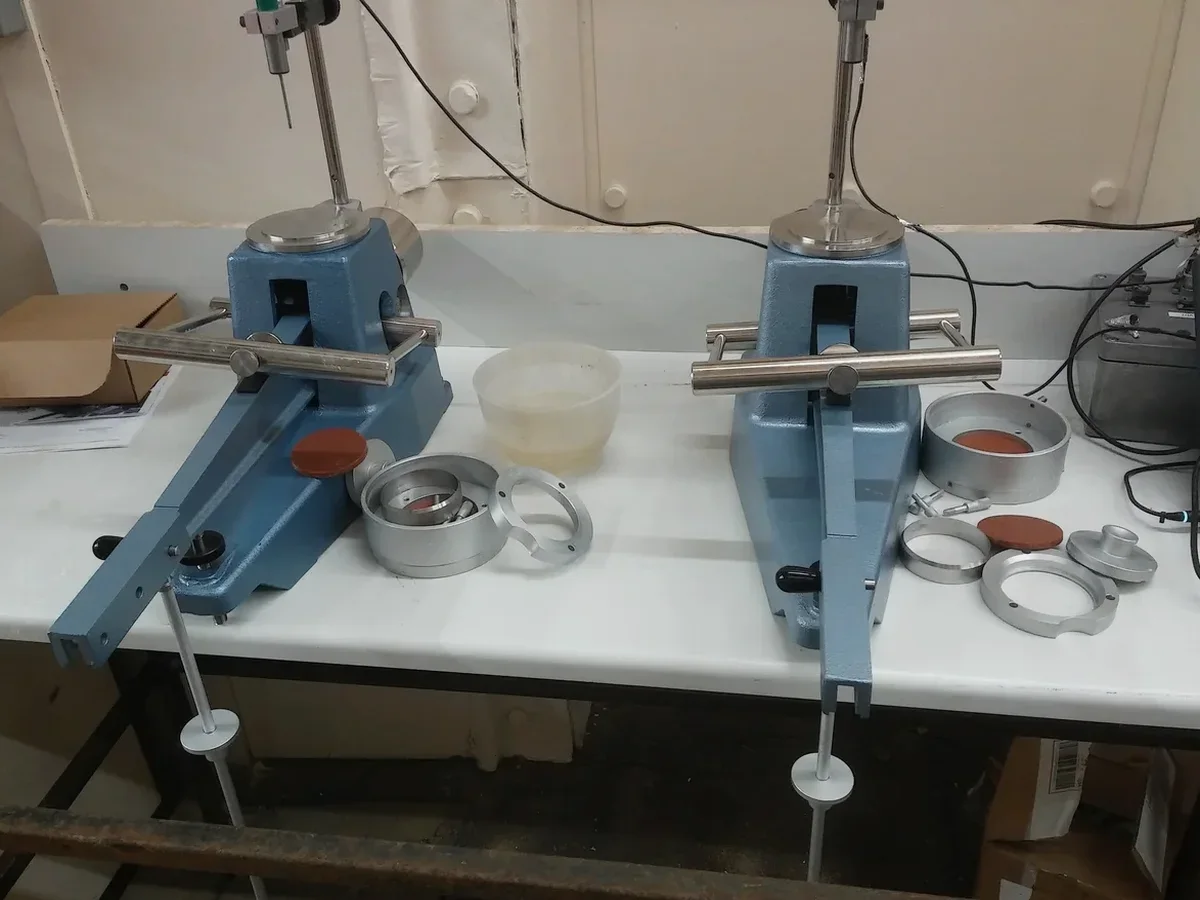
Multi-point Liquid Limit (Casagrande Method)
Full ASTM D4318 procedure using the Casagrande percussion cup. We run four to five water contents per sample, plot the flow curve, and report the liquid limit at 25 blows. This method captures the sensitivity of Oshawa's laminated silts far better than a fall cone on disturbed samples.
Plastic Limit and Plasticity Index Calculation
Thread-rolling technique to determine the moisture content at which the soil crumbles. The difference between LL and PL defines the plasticity index — a critical number for classifying the clay as CL, CH, or MH under the Unified Soil Classification System, directly influencing footing sizing per the Ontario Building Code.
Shrinkage Limit and Linear Shrinkage
For highly plastic clays encountered in the Oshawa Creek floodplain, we measure the shrinkage limit to predict the maximum volume reduction the soil will undergo upon drying. This is essential for designing moisture-barrier systems around foundations and underground parking structures.
Soil Classification Correlation Package
A combined report merging Atterberg limits with grain size distribution from hydrometer and sieve analysis. This package delivers a complete USCS classification and the AASHTO group index, ready for pavement design and earthwork specification compliance under OPSS standards.
Typical parameters
Common questions
What is the cost of Atterberg limits testing for a single Oshawa soil sample?
For a single disturbed sample, the standard Atterberg limits test (liquid limit and plastic limit) typically ranges from CA$100 to CA$140. The exact cost depends on whether the sample requires full multi-point determination or if a single-point liquid limit will suffice. Volume pricing is available for projects requiring testing on five or more samples from the same site.
How does a high plasticity index affect foundation design in Oshawa?
A high plasticity index — commonly above 25% in the glacio-lacustrine clays south of Rossland Road — indicates significant volume change potential with moisture variation. The geotechnical engineer will typically recommend deeper footings, thickened edge slabs, or removal and replacement of the active zone. The Ontario Building Code prescribes minimum footing depths that may be increased based on the plasticity data to reach undisturbed soil below the frost line and the zone of seasonal moisture fluctuation.
Can you run Atterberg limits on a sample with visible sand and gravel?
Yes, but the procedure follows ASTM D4318 with specific sample preparation. The material is wet-sieved through a No. 40 (425 µm) sieve, and the Atterberg limits are determined on the fine fraction. The percentage of coarse material is recorded separately. For Oshawa's Halton Till, which often contains a significant sand and gravel matrix, the plasticity of the fines alone controls the overall soil behavior. The lab reports both the fines plasticity and the overall gradation when requested.
What is the difference between the liquid limit and the plastic limit in practical terms?
The liquid limit is the water content at which a soil transitions from a plastic to a viscous liquid state, measured with the Casagrande cup at 25 blows. The plastic limit is the water content at which the soil crumbles when rolled into a 3-mm thread. The difference between them — the plasticity index — defines the range of moisture over which the soil behaves plastically. In Oshawa, a clay with a liquid limit of 48% and a plastic limit of 20% has a plasticity index of 28%, meaning it remains workable and moldable across a 28-percentage-point moisture range, a wide window that creates challenges for compaction and trench stability.
How fresh does the sample need to be for accurate Atterberg limits testing?
The reference range for this service in Oshawa is CA$100 - CA$140. The final price depends on the project scope and volume.