We recently completed a triaxial test program for a new warehouse off Bloor Street, right where the Halton Till meets the Oshawa Creek floodplain. The contractor was surprised by the silt content in the samples. He had assumed uniform clay. That assumption could have led to an undersized footing design. In our Oshawa lab, we run triaxial tests to prevent exactly this scenario. The triaxial test measures shear strength parameters under controlled drainage conditions. We see a lot of projects in Oshawa where the design team needs precise effective stress values. A standard triaxial test gives us cohesion and friction angle. Those numbers go directly into bearing capacity equations. For deep excavations near the Oshawa Centre, we combine the triaxial test with data from CPT testing to build a complete ground model.
A single triaxial test on an undisturbed sample tells you more about real soil behavior than a hundred index tests on remolded material.
Our approach and scope
Local ground factors
In Oshawa, one recurring issue we see is contractors treating all glacial deposits as the same material. They are not. The Halton Till has a dense, overconsolidated matrix. The glaciofluvial deposits interspersed within it drain much faster. Running the wrong triaxial test type on these soils produces misleading strength parameters. An undrained test on a free-draining sand gives a friction angle that is too conservative. A drained test on a low-permeability clay scheduled too fast will record excess pore pressure and underestimate effective stress. Another risk is sample disturbance. Oshawa's laminated lake clays are sensitive. A poorly taken Shelby tube sample will yield triaxial test results that are far below the in-situ strength. That leads to unnecessary deep foundations or ground improvement. We have seen projects where a proper triaxial test program reduced the foundation cost significantly compared to a design based solely on SPT N-values.
Regulatory framework
NBCC 2020 Section 4.2, CSA A23.3-19, ASTM D4767-11, ASTM D2850-15, ASTM D7181-20
Other technical services
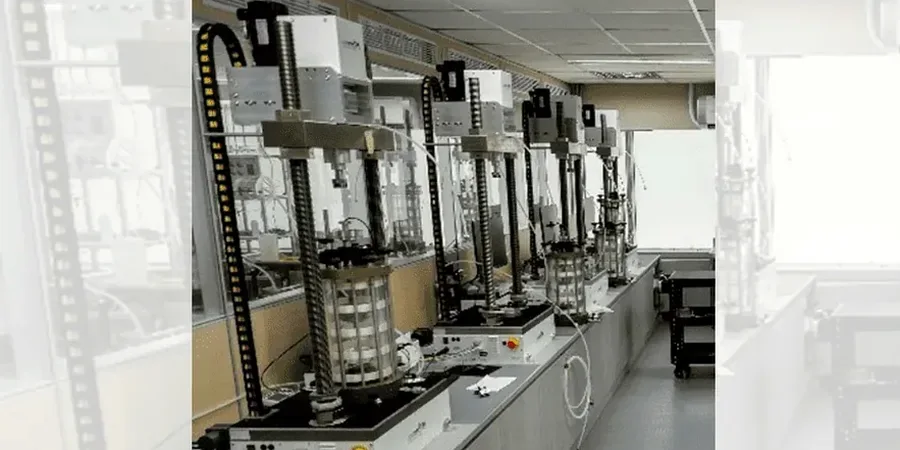
Consolidated Undrained (CU) Triaxial Test
With pore pressure measurement for effective stress analysis. The standard test for Oshawa's clayey silt and low-permeability till.
Unconsolidated Undrained (UU) Triaxial Test
Quick test for short-term stability during and immediately after excavation. Used for temporary shoring design in Oshawa's urban projects.
Consolidated Drained (CD) Triaxial Test
Slow test for long-term drained strength parameters. Essential for permanent retaining walls and slopes in free-draining granular soils.
Typical parameters
Common questions
How much does a triaxial test cost in Oshawa?
A standard triaxial test program in Oshawa typically ranges from CA$2,470 to CA$4,140 depending on the test type, number of confining pressures, and sample preparation requirements. A single UU test is at the lower end, while a full CD test suite at three confining pressures with pore volume change measurement reaches the upper end.
How long does a triaxial test take from sampling to report?
The timeline depends on the soil permeability and test type. A UU test on a silty clay sample takes two to three days. A CU test with back-pressure saturation on Oshawa's lacustrine clay needs seven to ten days for saturation and consolidation alone. A CD test on a sand sample runs faster, about five days. We always check the B-value before shearing. A complete report with the Mohr-Coulomb envelope is typically ready within two weeks from sample arrival.
What sample quality do you need for a reliable triaxial test?
Undisturbed samples are critical. We recommend thin-wall Shelby tubes for cohesive soils in Oshawa. The sample should be sealed immediately in the field with wax and stored upright. Transport time to the lab should be under 24 hours. For granular soils, we often prepare remolded specimens at the in-situ density. Disturbed samples with visible cracks or air voids are rejected. The quality of the triaxial test output depends entirely on the quality of the sample input.