Oshawa sits on the complex glacial stratigraphy of the Lake Ontario Iroquois Plain, where up to 40 meters of glaciolacustrine silty clays and till deposits overlie the Paleozoic limestone bedrock. The city’s moderate seismic hazard, classified under the 2020 National Building Code of Canada (NBCC) with a uniform hazard spectrum reflecting the Western Quebec Seismic Zone’s influence, demands careful consideration for critical facilities. Base isolation seismic design shifts the engineering approach from resisting ground motion to decoupling the structure from it entirely. For projects ranging from municipal infrastructure upgrades to industrial retrofits near the waterfront, we help clients navigate the performance-based design requirements of NBCC Clause 4.1.8. The local soil profile—often a soft upper crust over stiffer lodgement till—amplifies short-period ground motions, making isolation a technically sound choice when combined with a detailed seismic microzonation assessment.
Decoupling a building from ground motion in Oshawa means designing for the thick glaciolacustrine clay—where amplification factors can exceed 2.0 at periods below 0.5 seconds.
Our approach and scope
Local ground factors
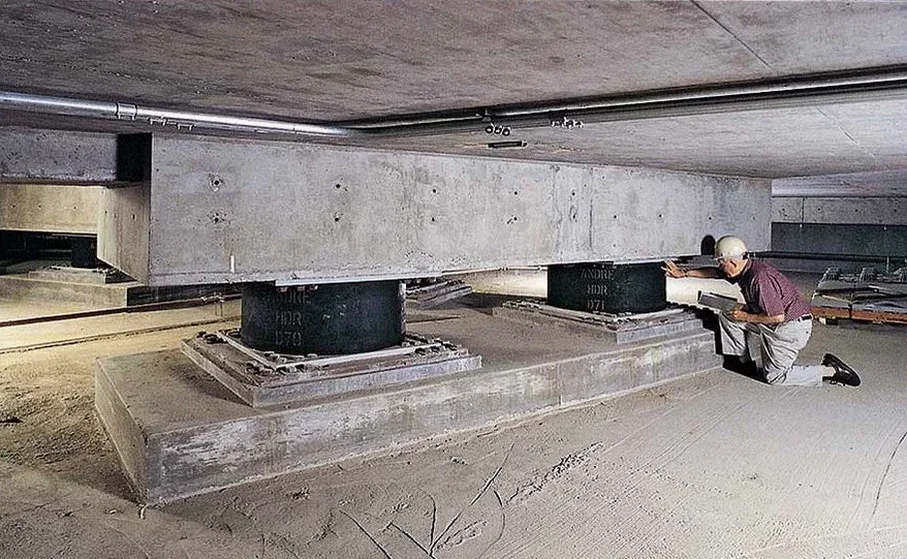
Oshawa’s population of approximately 175,000 residents concentrates critical infrastructure along the Highway 401 corridor and the lakeshore, where the water table sits high within the overburden. A structure without proper seismic isolation on these saturated silty clays faces two threats: amplified short-period shaking that can shear non-structural elements, and post-earthquake consolidation settlement that compromises foundation integrity. The 2010 Val-des-Bois earthquake, though centered in Quebec, was felt across eastern Ontario and reminded municipalities of the regional seismic connectivity. Base isolation seismic design mitigates both hazards. By lengthening the fundamental period to the 2.5–3.5 second range, isolation bearings bypass the energy-dense part of the spectrum where glacial soils amplify motion. We incorporate moat wall retaining systems and flexible utility connections into the design package so that gas, water, and electrical solutions remain operational through the design displacement.
Regulatory framework
NBCC 2020 (National Building Code of Canada) – Part 4, Clause 4.1.8, CSA S832-14 (R2019) – Seismic Risk Reduction of Operational and Functional Components of Buildings, CSA A23.3-19 – Design of Concrete Structures
Other technical services
Nonlinear Time-History Analysis & Isolator Specification
We develop 3D structural models incorporating isolator hysteretic behavior calibrated to site-specific spectra. Deliverables include displacement demand estimates, stability checks under maximum vertical load, and a performance specification for bearing procurement in compliance with NBCC 2020 and CSA S832.
Construction Support & Prototype Testing Oversight
On-site review of isolator pedestal formwork and reinforcement per CSA A23.3, verification of moat wall geometry against design clearance, and coordination of prototype bearing testing—including full-scale shear and compression tests—before production lot approval.
Typical parameters
Common questions
What is the typical cost range for a base isolation seismic design package on a mid-rise building in Oshawa?
For a comprehensive design package covering nonlinear analysis, isolator specification, and construction review for a typical mid-rise structure in Oshawa, fees generally range from CA$5,460 to CA$12,490. The scope includes site-specific ground motion selection, 3D modeling, and prototype testing coordination.
How does the NBCC 2020 address base isolation compared to older code editions?
NBCC 2020 references CSA S832 explicitly for seismic isolation design and requires nonlinear time-history analysis using not fewer than 11 ground motion pairs selected to match the site’s uniform hazard spectrum. The code mandates that both the design-basis earthquake and the maximum considered earthquake be evaluated, with explicit limits on residual displacement and uplift for individual isolators.
Is base isolation feasible on Oshawa's glacial clay soils?
Yes, it is feasible and often beneficial. The soft upper silty clays amplify short-period motion; base isolation shifts the structural period beyond the amplified range. However, the foundation system beneath the isolation plane must be designed to resist bearing capacity loss under cyclic loading. We typically pair the isolation design with a deep foundation solution—such as drilled shafts socketed into the till or bedrock—to supply a stable base for the isolator pedestals.