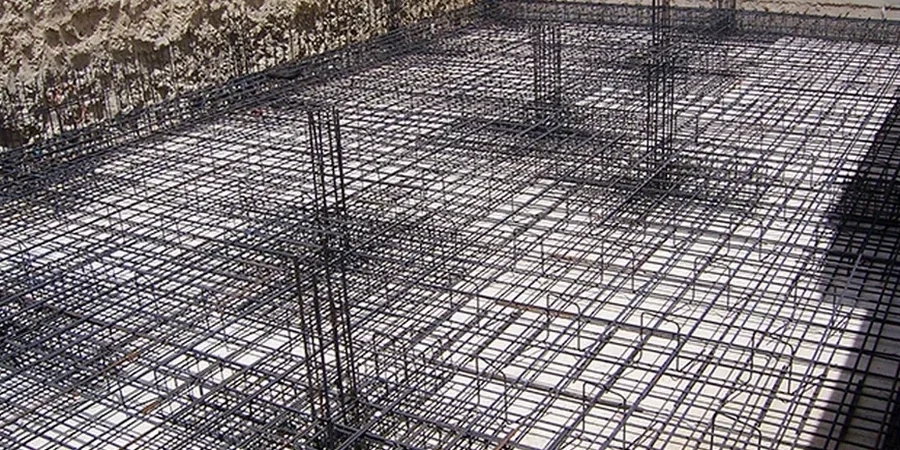
Oshawa’s rapid transformation from a mid-century manufacturing hub to a modern logistics and residential center has pushed new construction onto parcels that earlier generations of builders often bypassed. The northern sections of the city sit on dense Halton Till, which offers excellent bearing, but the southern half — especially around the former Lake Iroquois shoreline — transitions into laminated silts and clays where differential settlement becomes the controlling design parameter. When we review a site near Stevenson Road or down by the Second Marsh, it is rarely the ultimate bearing that governs the foundation strategy; it is the long-term consolidation behavior of the native soil and the need to bridge localized soft pockets that standard footings simply cannot handle. A rigid mat slab, proportioned using an iterative soil-structure interaction model, distributes column loads over the full footprint and keeps total and differential movement within NBCC serviceability limits. For clients expanding cold-storage warehouses or adding mezzanine-level loads in older industrial buildings, we often pair the raft analysis with results from a triaxial shear test to anchor the constitutive soil parameters in measured effective stress behavior rather than generic correlations.
A well-designed raft in Oshawa’s transitional soils does more than support columns — it averages out the settlement troughs that would crack a conventional footing system within the first five years of service.
Our approach and scope
Local ground factors
Oshawa’s weather swings from saturated spring thaw to deep summer drought create an annual cycle of volumetric change in the near-surface clay crust that standard spread footings feel acutely. A raft foundation decouples the superstructure from these shallow moisture fluctuations, but the design must still account for the deeper regional compressibility of the glaciolacustrine deposits that blanket much of the Lake Ontario Plain. In our background, the most expensive geotechnical surprises in Oshawa come from irregular bedrock topography — the limestone and shale of the Verulam and Lindsay formations can step down ten meters across a single city block, leaving a compressible drift-filled trough directly under one quadrant of the building. We map these transitions with a combination of seismic refraction profiling and targeted boreholes before finalizing the mat geometry, ensuring the raft’s rigidity is tuned to the actual thickness of the soil column it will bear on. Skipping this step leads to tilting that no amount of post-tensioning can economically correct.
Regulatory framework
NBCC 2020 (National Building Code of Canada), CSA A23.3-19 (Design of Concrete Structures), OBC (Ontario Building Code, with local amendments), ASTM D1194 (Plate load test — when in-situ ks is required), CSA S6:19 (Canadian Highway Bridge Design Code, for heavy industrial mats)
Other technical services
Raft thickness and reinforcement optimization
We use 3D finite element models calibrated to site-specific CPT and triaxial data to determine the minimum raft thickness and rebar layout that satisfies ULS and SLS requirements under Oshawa soil conditions.
Settlement monitoring and construction-phase verification
During concrete placement and initial structural loading, we install settlement plates and inclinometer casings to confirm that the mat is performing within the predicted deformation envelope.
Existing foundation retrofit with supplemental mats
For Oshawa’s aging industrial buildings requiring crane upgrades or mezzanine additions, we design interconnected mat extensions that stiffen the existing footing network without full demolition.
Typical parameters
Common questions
When is a raft foundation necessary instead of isolated footings in Oshawa?
A raft becomes the logical choice when the combined footing area exceeds roughly half the building footprint, or when the soil profile south of Highway 401 shows more than three meters of compressible silt and clay. We also specify rafts when column loads exceed 1500 kN and the allowable bearing pressure on the native till or fill is below 150 kPa, because the mat engages the entire plan area to keep total settlement within the NBCC 25 mm guideline.
How does the Oshawa Creek valley influence raft foundation design?
Properties within 200 meters of the Oshawa Creek ravine system often sit on a complex transition zone where the Halton Till thins and glaciolacustrine silts dominate. The valley walls can background long-term lateral creep, so we design the raft with a perimeter stiffening beam that acts as a shear key, and we model the slope’s influence on the foundation using a coupled geotechnical-structural analysis that accounts for reduced passive resistance on the valley side.
What is the typical cost range for a raft foundation design in Durham Region?
For a standard industrial or commercial building in Oshawa, the engineering design package — including site investigation coordination, soil-structure interaction modeling, and stamped construction drawings — generally falls between CA$1,230 and CA$5,300 depending on the building footprint, number of column load cases, and whether we need to run a seismic soil-structure interaction analysis per NBCC 2020 requirements.
How do you verify the subgrade reaction modulus for a raft on Oshawa’s glacial till?
We prefer to derive the modulus of subgrade reaction from in-situ plate load tests performed at the proposed founding level, because the till’s stiffness can vary by a factor of three across a site depending on its sand lens content and preconsolidation history. When access or budget limits plate testing, we back-calculate ks from CPT cone resistance using the Mayne (2001) correlation, then calibrate it against at least one borehole with SPT N-values to confirm the till facies interpretation.