The 2020 National Building Code of Canada (NBCC) and CSA A23.3 set strict requirements for earth retaining structures, and Oshawa’s geology demands careful application of these standards. The city sits on a complex mix of glacial till, sand, and sensitive clay deposits left by Lake Iroquois, with the Oshawa Creek valley cutting through the urban core. A retaining wall here does more than hold back soil—it manages variable groundwater, frost action, and the lateral pressures that come with Durham Region’s freeze-thaw cycles. Without a site-specific geotechnical analysis, designing to the code’s limit states becomes guesswork. We combine in-situ investigation with laboratory testing to define the earth pressure coefficients, bearing capacity, and backfill parameters that directly feed structural calculations. When the wall must support a roadway or a commercial foundation near the waterfront, integrating data from an SPT drilling program provides the N-values and soil stratigraphy needed to confirm the design assumptions.
Oshawa’s glacial stratigraphy creates sharp transitions from dense till to soft clay—a wall designed for one may fail in the other if the geotechnical model isn't verified by drilling.
Our approach and scope
Local ground factors
The freeze-thaw cycle in Oshawa, with average January lows of -10°C, introduces frost penetration depths that can exceed 1.2 meters in exposed silty soils. A retaining wall without adequate drainage and frost protection will background ice lensing behind the stem, generating lateral pressures far beyond the design envelope. Then comes the spring melt and heavy rain events—Oshawa Creek can rise quickly, saturating backfill and reducing the effective stress that holds the wall stable. We specify free-draining granular backfill, continuous weep holes or strip drains, and a frost taper where the wall faces north. In the Lake Iroquois plain, the presence of sensitive clay layers adds another hazard: if excavation for the wall base disturbs these clays, a sudden loss of strength can trigger a bearing failure. Our designs always include a site-specific frost depth calculation and a drainage plan tied to the local groundwater regime observed during the investigation.
Video resource
Regulatory framework
NBCC 2020 – National Building Code of Canada, CSA A23.3:19 – Design of Concrete Structures, OPSS 206 – Grading (Ontario Provincial Standard Specification), ASTM D698 – Standard Proctor for Backfill Compaction
Other technical services
Reinforced Concrete Cantilever Wall Design
For commercial and municipal projects requiring heights over 2.5 meters. Includes bearing capacity verification on glacial till, sliding and overturning checks, and a drainage specification that meets Ontario Building Code requirements. We supply the stem and base reinforcement recommendations based on the lateral earth pressure diagram derived from site-specific soil parameters.
Gravity and Segmental Block Wall Analysis
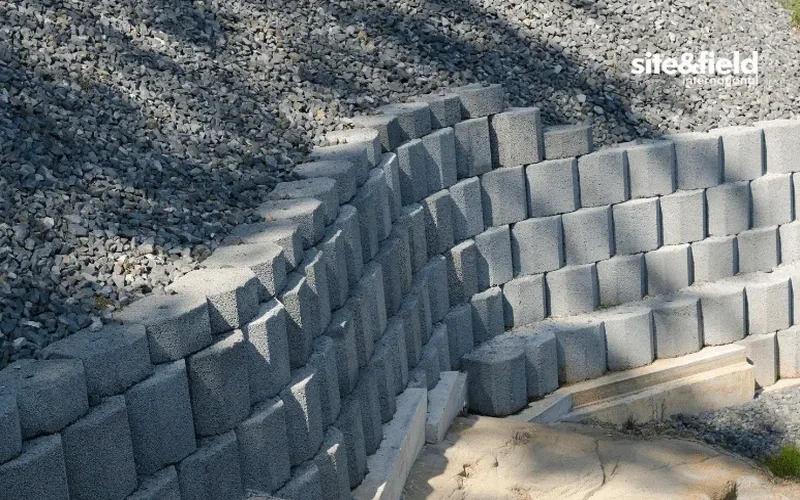
For residential landscaping, driveway cuts, and low-height commercial applications. We evaluate the foundation soil’s allowable bearing pressure and the global stability of the reinforced soil mass. The analysis includes a compaction specification for the granular backfill and a frost protection detail suited to Oshawa’s climate zone.
Typical parameters
Common questions
What is the typical cost range for a retaining wall design in Oshawa?
For a site-specific geotechnical investigation and the corresponding retaining wall design package, the cost typically falls between CA$1,600 and CA$5,770. The final figure depends on the wall height, the number of boreholes required along the alignment, and whether the site is in the Oshawa Creek valley or on the upland till plain, where access and soil conditions differ.
How deep do you investigate below the proposed wall base?
We typically extend the investigation to a depth of at least 1.5 times the wall height below the proposed base, or until we reach a competent bearing stratum with sufficient thickness. In Oshawa, where glacial till overlies shale bedrock at variable depths, we confirm refusal or core the bedrock if the wall loads are high.
Do you handle the structural design of the wall, or just the geotechnical parameters?
We supply the complete geotechnical design parameters—earth pressures, bearing capacity, sliding resistance, and backfill specifications. Our package also includes preliminary wall dimensions and reinforcement recommendations. The final structural detailing and shop drawings are typically completed by a structural engineer using our geotechnical report as the basis of design.
How do you account for seismic loads in Oshawa?
Oshawa is in a moderate seismic zone. We apply the NBCC 2020 seismic hazard values for the site and calculate the incremental dynamic earth pressure using the Mononobe-Okabe method. For walls retaining saturated, loose sands, we also evaluate the liquefaction potential using SPT data and Seed & Idriss simplified procedure, and we adjust the design if a reduction in soil strength is predicted. More info.