Designing a footing in north Oshawa versus the Lakeview area is not the same job. North of Taunton Road you hit dense glacial till within a meter or two. Down near the lake, you find compressible clay bands left by the old glacial Lake Iroquois shoreline. That difference dictates whether you need a standard strip footing or a stiffened mat. Our lab team runs the plate load test on these till units to get a direct modulus of subgrade reaction. We also sample for grain size analysis because a silty till behaves very differently from a washed sand under cyclic loading. In Oshawa, you design for what is actually there, not what the regional map says.
A 600 mm wide footing on dense Oshawa till can hold more load than a 900 mm footing on wet silt. Proof comes from the plate test.
Our approach and scope
Local ground factors
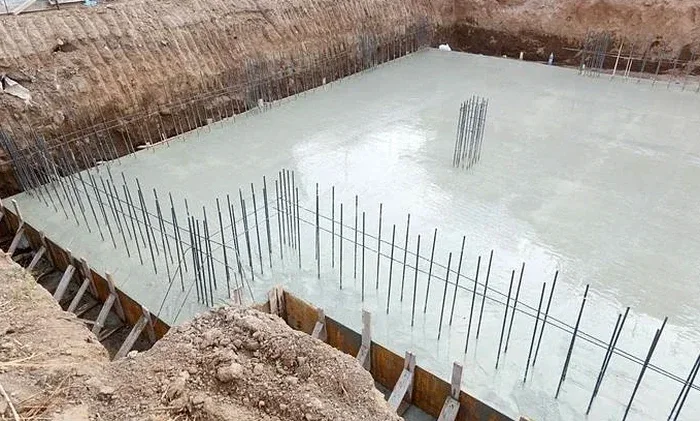
In Oshawa we often see builders pour the footing concrete directly onto frozen ground in February. That is a guaranteed call-back in April. The thaw turns the frozen silt into slurry and the footing loses edge support. Cracking follows. We require the subgrade to be covered with insulated blankets overnight if the pour is early morning. Another common issue is water ponding in the excavation. Oshawa clay heaves when it gets wet. We specify a mud slab or a lean concrete seal within four hours of final trim. Ignoring this turns a simple spread footing job into a long-term settlement problem. The Ontario Building Code references NBCC for bearing capacity and frost protection. We follow the code strictly.
Regulatory framework
NBCC 2020 (National Building Code of Canada), CSA A23.3:19 (Design of Concrete Structures), ASTM D1194 (Plate Load Test, referenced for modulus)
Other technical services
Bearing Capacity Assessment
We correlate SPT N-values and plate test data to give you a site-specific allowable bearing pressure. No generic 150 kPa assumptions.
Settlement Analysis
We run immediate and consolidation settlement calculations using oedometer data from the lab. We flag differential settlement risks between column lines.
Frost Protection Design Review
We confirm the foundation depth meets NBCC requirements for Zona 2. We also check for frost-susceptible silts that require deeper excavation.
Typical parameters
Common questions
What is the cost for a shallow foundation design report in Oshawa?
For a typical single-family home or small commercial building in Oshawa, the combined field investigation and design report ranges from CA$2,890 to CA$4,570. The final price depends on the number of test pits, the need for plate load testing, and laboratory consolidation tests.
How deep do footings need to be in Oshawa to avoid frost?
The NBCC places Oshawa in a zone requiring at least 1.2 m of soil cover. We verify this depth on site. If we find frost-susceptible silt, we recommend extending the footing to 1.4 m or installing rigid insulation beneath the slab.
Can you design a shallow foundation on Oshawa clay?
Yes, but we need to manage settlement. We often widen the footing to reduce bearing pressure and use a stiffened raft if the clay is soft. Our lab runs consolidation tests to predict how much and how fast the clay will settle.
Do you provide the concrete reinforcement design?
We specify the geotechnical parameters: bearing pressure, subgrade modulus, and sulfate exposure class. The structural engineer uses our report to size the rebar per CSA A23.3. We do not stamp structural reinforcement drawings.
How long does it take to get the foundation report?
Field work takes one day for a standard lot. Lab tests on the soil samples run for about five to seven business days. You receive the final stamped report within ten working days after we finish on site.