The drilling rig’s split-spoon sampler drives into the glacial till that defines so much of Oshawa’s subsurface, retrieving soil from depths where weathered shale meets dense lodgement till. A soil mechanics study in Oshawa captures this transition—from the sandy silts of the Lake Ontario plain to the underlying bedrock of the Lindsay Formation. With a population surpassing 180,000 and a development corridor pushing northward into former agricultural land, understanding the stress history and consolidation characteristics of these deposits is essential. The team extracts Shelby tubes and conducts standard penetration tests, logging each layer according to the Canadian Foundation Engineering Manual. Oshawa’s post-glacial stratigraphy, influenced by the former Lake Iroquois shoreline, creates lateral variability that demands more than textbook assumptions. A CPT test often supplements borehole data in the city’s low-lying industrial zones, where soft, compressible clays can extend to depths of 25 meters.
Oshawa’s glacial stratigraphy demands a soil mechanics approach that accounts for rapid lateral transitions from dense till to compressible clay within a single city block.
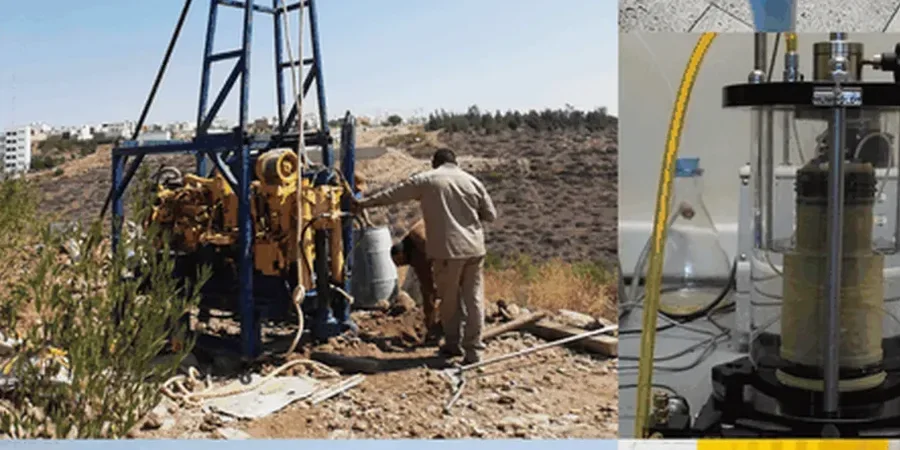
Our approach and scope
Local ground factors
A common oversight among contractors working in northern Oshawa is treating the stiff upper crust of weathered till as competent bearing material without verifying its thickness through a proper soil mechanics study. This desiccated zone, typically 1 to 3 meters thick, sits above softer, normally consolidated material that can yield unexpectedly under footing loads exceeding 150 kPa. Differential settlement becomes the primary risk—one corner of a foundation bearing on dense till, another on a buried channel infill of soft organic silt. The paleo-valleys carved into the bedrock surface across Durham Region, sometimes filled with compressible deposits up to 20 meters deep, are invisible from the surface. Seismic site classification per NBCC 2020 Table 4.1.8.4.A can shift from Class C to Class D or even E when these features are missed, altering design spectral accelerations and foundation requirements.
Regulatory framework
NBCC 2020 (National Building Code of Canada), CSA A23.3:19 (Design of Concrete Structures), ASTM D1586 (Standard Penetration Test), ASTM D4767 (Consolidated Undrained Triaxial), Canadian Foundation Engineering Manual (CFEM) 4th Ed.
Other technical services
Laboratory Soil Testing Suite
Classification tests including grain size analysis and Atterberg limits, combined with strength testing—triaxial compression, direct shear, and unconfined compression—executed under CSA and ASTM protocols to determine the engineering parameters of Oshawa’s glacial and post-glacial deposits.
In-Situ Geotechnical Investigation
Borehole drilling with SPT sampling, cone penetration testing in soft clay zones, and test pit excavation for visual logging of fill and groundwater conditions, referenced to the Oshawa area’s Quaternary geology maps and the CFEM.
Typical parameters
Common questions
What is the typical cost range for a soil mechanics study for a residential lot in Oshawa?
For a standard residential lot in Oshawa, a soil mechanics study typically ranges from CA$4,610 to CA$7,420. The final cost depends on the number of boreholes required, the depth to bedrock, and the laboratory testing program specified by the geotechnical engineer. Sites near Oshawa Creek or with known fill may require additional investigation.
Which soil types in Oshawa are most problematic for foundations?
The glaciolacustrine clays found in low-lying areas near the Lake Ontario shoreline are the most challenging. These deposits exhibit low shear strength and high compressibility, leading to long-term settlement. The organic silts infilling buried bedrock valleys across Durham Region also present significant consolidation and differential settlement risks.
How deep do you typically drill for a geotechnical investigation in Oshawa?
Borehole depth depends on the structure and the site geology. For a typical residential foundation, boreholes extend to 6–8 meters below grade. For commercial buildings or where bedrock is deeper, drilling may reach 15–25 meters. The investigation must penetrate through any compressible layers into competent till or bedrock, per the guidelines in the Canadian Foundation Engineering Manual.
What seismic site class is common for Oshawa soils?
Most of Oshawa falls under Site Class C or D according to the NBCC 2020 classification. Areas underlain by thick deposits of soft clay or loose sand, particularly near the lakeshore and within buried bedrock valleys, can be classified as Site Class E. A site-specific shear wave velocity measurement or SPT-based correlation is required to confirm the final class for structural design.