Anchor design in Oshawa must address the layered glacial deposits that define the city's subsurface. The Ontario Building Code, referencing NBCC 2020, sets clear requirements for temporary and permanent earth retention. Our design team works directly with site superintendents to develop anchor layouts that hold under the high lateral pressures common in the city's dense till and silt zones. We prepare sealed shop drawings and load test specifications for active tiebacks and passive soil nails. For projects near Oshawa Creek or the Lake Ontario shoreline, the presence of saturated sands demands careful unbonded length calculation. A single anchor failure can stall a whole excavation sequence. We coordinate design submittals with the geotechnical report and supply on-site verification during proof testing to confirm that bond zones mobilize as predicted.
Anchor bond length in Oshawa's Halton Till typically mobilizes between 15 and 25 kPa per meter of bond, verified by on-site tension testing.
Our approach and scope
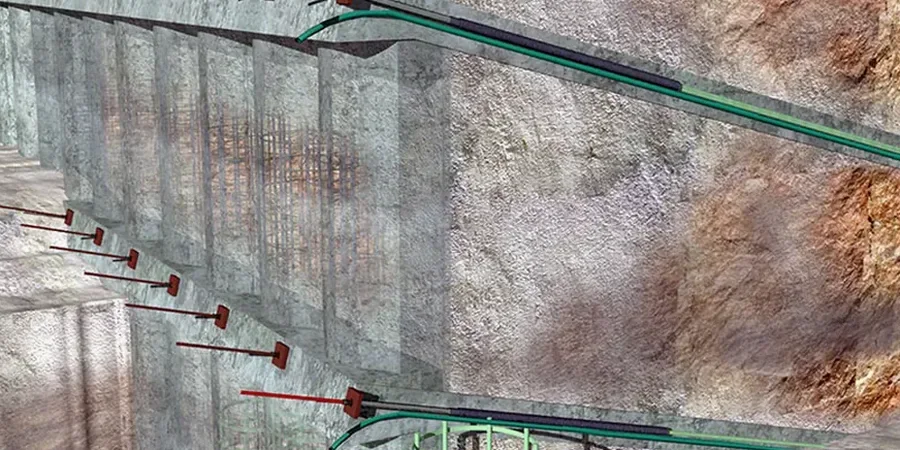
Local ground factors
Anchor performance varies notably between Oshawa's north and south sectors. In the northern subdivisions near the moraine crest, silty clay tills can be overconsolidated and stiff but prone to softening if water infiltrates the bond zone. In the southern industrial corridor near Wentworth Street, deeper sand units with artesian potential require full-length casing during drilling to prevent hole collapse. The biggest schedule risk is an anchor that fails proof testing because the soil-grout interface was overestimated. We address this by specifying sacrificial test anchors early in the program. Load-locking procedures must also consider thermal effects on hydraulic jacks during Oshawa's cold-season construction. A lock-off load set at -15°C will drop measurably when the steel tendon contracts further overnight. Our installation protocols include temperature compensation charts specific to each project's anchor configuration.
Regulatory framework
NBCC 2020 (National Building Code of Canada), CSA A23.3 Design of Concrete Structures, Anchorage provisions, CSA Z165 Site Investigation Standard, PTI DC-35.1 Recommendations for Prestressed Rock and Soil Anchors, ASTM A944 Standard Test Method for Bond Strength of Anchor Bars
Other technical services
Tieback Anchor Design
Calculation of unbonded and bond lengths for active tiebacks. Includes soldier pile or shotcrete wall load distribution and global stability checks. Sealed for building permit submission in Oshawa.
Soil Nail Wall Design
Passive anchor design for top-down excavations. We supply nail spacing, inclination, and facing details per CAN/CSA-S6 for temporary and permanent applications.
Anchor Testing & Verification
On-site proof testing, creep testing, and lift-off testing. We supply calibrated jacks, dial gauges, and the test procedure documentation that Oshawa inspectors require.
Anchor Inspection & Load Monitoring
Long-term monitoring of lock-off loads using load cells. We track relaxation over time and supply reports for the project file, a requirement for anchors under public rights-of-way.
Typical parameters
Common questions
What is the difference between active and passive anchors for an excavation in Oshawa?
Active anchors are post-tensioned and locked off against the wall face immediately after grout reaches strength. They prevent movement before excavation continues. Passive anchors, like soil nails, are not stressed; they engage only when the wall deflects during subsequent lifts. In Oshawa's stiff Halton Till, active tiebacks let you control settlement behind the wall—critical when excavating next to an existing building on Simcoe Street.
What load can a soil anchor hold in Oshawa's glacial till?
Working loads typically range from 100 kN to 600 kN per strand anchor in Oshawa's overconsolidated till, depending on bond length and grouting method. We design to a bond stress of 15-25 kPa per meter in the till layer, but this value must be confirmed by an on-site sacrificial test anchor. Sand layers below the till can sometimes achieve higher bond with post-grouting techniques.
How much does anchor design cost for an Oshawa project?
Anchor design and testing specification packages for Oshawa projects range from CA$1,240 for a straightforward soil nail wall section to CA$5,910 for a full tieback system with multiple anchor rows and detailed load test procedures. The scope includes sealed calculations, shop drawings, and the on-site testing supervision required by the city's building department.
How long does anchor installation and testing take in Oshawa?
Drilling, grouting, and curing typically takes 3 to 5 days per anchor row. Active anchors require an additional 24 to 48 hours for grout to reach 30 MPa before stressing. A full proof test on a single anchor takes about 45 minutes. For an Oshawa project with 30 tiebacks on a 3-meter grid, expect the anchor work to run 2 to 3 weeks including all load testing and lock-off documentation. More info.