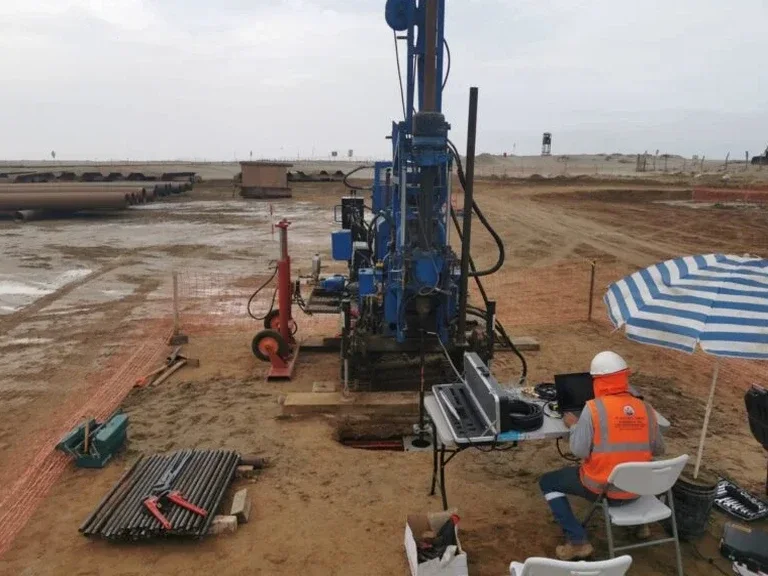
Oshawa's transition from a manufacturing hub to a rapidly expanding residential and logistics center has put new pressure on its underlying geology. The city sits on a complex mix of glacial till plains, Lake Iroquois shoreline deposits, and deep alluvial valleys carved by the Oshawa Creek watershed. We've worked on projects where the soil changes from stiff clayey silt to loose sand within a 50-meter span—exactly the scenario where a standard borehole alone doesn't tell the full story. To safely support the new wave of mid-rise condos near the downtown core, our team relies on the CPT (Cone Penetration Test) for continuous, real-time stratigraphic data. We combine field results with laboratory verification, including grain size analysis to confirm the silty zones that often control drainage and settlement behavior in this part of Durham Region.
In Oshawa's glacial terrain, a CPT log every two centimeters reveals the thin sand lenses that a split-spoon sampler usually misses—and that's where the settlement risk hides.
Our approach and scope
Local ground factors
At 43.8976°N latitude, Oshawa sits in a seismic zone classified under the 2015 NBCC with a spectral acceleration that demands attention to soil-structure interaction. The biggest mistake we see is relying on SPT blow counts alone in the varved clays of the former glacial lake bed. These soils can produce misleading N-values while concealing sensitive, quick-clay layers at depths between 8 and 15 meters. A CPT (Cone Penetration Test) measures undrained shear strength directly through cone resistance, flagging these weak horizons before the excavator reaches them. On a recent warehouse project near the 401, our CPTu profile identified a 1.2-meter-thick zone of underconsolidated silt that the preliminary borehole logs had averaged into a generic “clay till” description. Redesigning the footing depth saved the owner six figures in potential differential settlement repairs.
Regulatory framework
ASTM D5778-20 (Electronic Friction Cone and Piezocone Penetration Testing), CSA A23.3 (Design of Concrete Structures – soil parameter input), Ontario Building Code (O. Reg. 332/12 as amended, Part 4 commentary), Robertson (2016) Soil Behaviour Type (SBTn) classification chart
Other technical services
Seismic CPT (SCPTu)
We lower a triaxial geophone behind the cone to measure shear wave velocity (Vs) every 1-meter interval. This data feeds directly into site class determination per NBCC Table 4.1.8.4.A, critical for the 5- to 12-story buildings now common in Oshawa’s urban growth centre.
CPTu with HPT (Hydraulic Profiling Tool)
For brownfield redevelopments near the former GM assembly lands, we pair cone data with hydraulic profiling to map contaminant migration pathways in the upper 10 meters. The HPT injects water at controlled flow while logging pressure, giving a continuous permeability estimate alongside the standard CPT parameters.
Typical parameters
Common questions
How deep can a CPT rig go in Oshawa's typical soil conditions?
In the Halton Till and glacial deposits common around Oshawa, our tracked 20-tonne CPT unit typically reaches 25 to 30 meters before encountering refusal on dense boulder-rich till or shale bedrock. In the softer alluvial soils along Oshawa Creek, we've pushed to over 35 meters. We pre-auger through pavement or fill when needed, and if the cone hits refusal above your target depth, we discuss transitioning to a complementary test method rather than forcing the equipment past its safe working limit.
Does the Ontario Building Code accept CPT data for foundation design?
Yes. The 2012 Ontario Building Code (O. Reg. 332/12) with its 2019 amendments references CSA A23.3 and allows the use of CPT-derived parameters for foundation design when performed under professional geotechnical supervision. Our reports include interpreted soil behavior type (SBTn), equivalent SPT N60 values, undrained shear strength for cohesive layers, and friction angle for granular layers—all parameters that structural engineers can apply directly to bearing capacity and settlement calculations.
What's the typical cost for a CPT investigation in Oshawa?
For a standard CPTu sounding with pore pressure dissipation tests, budget between CA$220 and CA$300 per meter mobilized on site. A typical single-family residential investigation with three soundings to 15 meters depth generally runs in the CA$9,900 to CA$13,500 range, including mobilization within Durham Region, real-time data acquisition, and a signed engineering report. Seismic CPT (SCPTu) adds about 20 percent to the meter rate due to the additional geophone and processing time. We supply a fixed-price proposal after reviewing your project drawings and site access constraints.
Can you use CPT to assess liquefaction potential in Oshawa?
Absolutely. The continuous CPT record is the preferred input for the Boulanger and Idriss (2014) liquefaction triggering procedure referenced in NBCC commentary. We calculate the factor of safety against liquefaction at each data point, accounting for Oshawa's design earthquake magnitude and the water table depth measured during pore pressure dissipation tests. The method is particularly effective in the loose saturated sands found in the lower Oshawa Creek valley, where thin, critical layers might be missed by SPT testing at 1.5-meter intervals.
How long does a CPT testing program take from mobilization to report delivery?
Fieldwork for a standard residential or small commercial site in Oshawa—typically three to five soundings—completes in one day on site. We handle utility locates and traffic control if you're working near arterial roads like Simcoe Street or Bloor Street. The geotechnical report with interpreted soil profiles, engineering parameters, and foundation recommendations is delivered within five to seven business days after the field work. For larger industrial projects or SCPTu programs, we'll give you a detailed schedule at the proposal stage.